


- This event has passed.
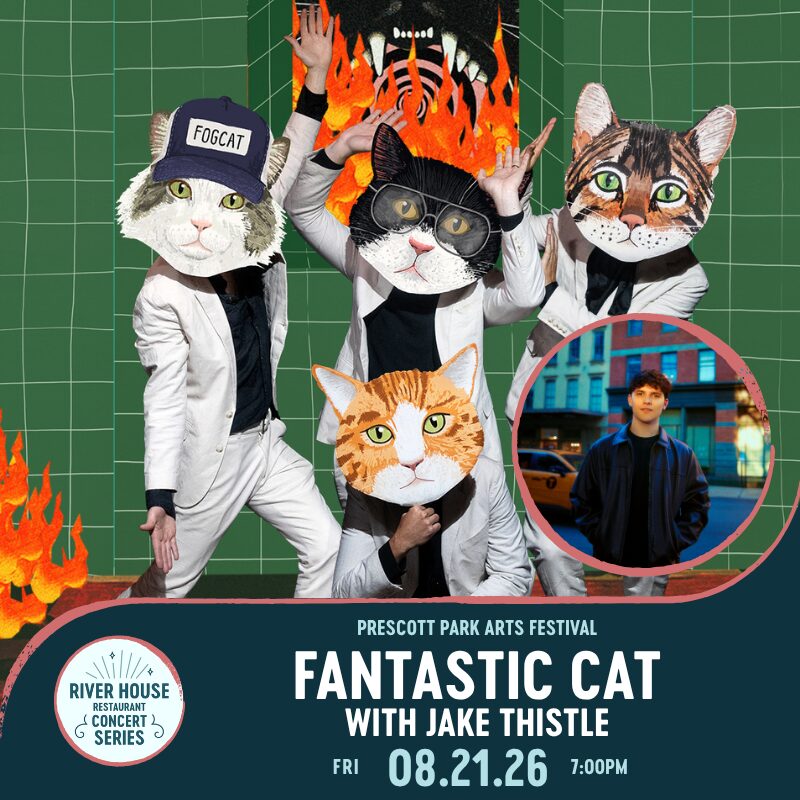
Fantastic Cat with Jake Thistle
presented by the River House Restaurant
Want to pre-order a delicious bite from one of our restaurant partners? Click the ‘Make a Reservation’ button below:
General Admission Donations do not include reserved seating. This is a way to make your gate donation in advance. Thank you!

Fantastic Cat almost died. Each member also individually (but at separate times) faced devastating heartbreak, went to jail, got sober, almost quit music entirely, reconnected with a long-estranged family member, started making music again, hit rock bottom, had a chance encounter with a mysterious stranger who changed their perspective on life, almost quit music entirely a second time, reconciled their progressive, liberal ways with their strict, conservative upbringing, and embraced the raw power of their sexuality. It was quite a summer.
And sure, you may be reading this right now saying, “Wow, that kind of sounds like the band just basically jammed every bio cliché they could think of into a single paragraph without anything to back it up in a pathetically transparent attempt to generate press coverage.” But that kind of cynical thinking is exactly why GQ owns Pitchfork now (or whatever the hell happened there).
Anyway, it’s all real, and if it makes for the kind of inspirational headline that editors and advertisers alike both find highly clickable, then so be it.
You see, two years ago, Fantastic Cat was nothing more than a little-known rock and roll band with a cult following (their fans were primarily members of Heaven’s Gate). That all changed with the release of their award-eligible debut, The Very Best Of Fantastic Cat, which garnered the kind of press you simply can’t make up. USA Today proclaimed, “we don’t have a music writer anymore,” while NPR received multiple copies of the album in the mail, and The New York Times’ Jon Pareles declared, “I’m currently out of the office and will respond when I return.”
Success went to the supergroup’s head, though, and through a series of dramatic events almost too unbelievable to recount in specific, verifiable detail, they nearly lost everything, only to triumphantly overcome their seemingly insurmountable setbacks in a way that just begs for a Judd Apatow-produced HBO Max documentary (or at the very least, a decent Spotify playlist placement somewhere closer to the top than the bottom).
Today, Fantastic Cat is back and older than ever, taking America (and the nicer parts of Europe) by storm with their smash hit new album, Now That’s What I Call Fantastic Cat, which, as of this writing, hasn’t technically been released yet, but seems almost certain to be a huge success based on industry trends and corporate forecasting.
Galvanized by a transformative journey into the spiritual vortices of the Pocono Mountains, the band found inspiration for their sophomore effort in the world of mind-expanding psychedelics: they dropped antacids, experimented with mushrooms (primarily porcini), and even began microdosing a variety of hard seltzers. The result was an album that could only be described as “Christopher Cross crossed with Kris Kristofferson,” a bewildering blend of stepdad rock and inlaw country destined to solidify their status as your least favorite songwriter’s favorite songwriters. But no one hit the record button, and the sessions went mercifully undocumented.
Instead, the album they turned in to the label is an entirely different collection, one that meets (but does not exceed) the minimum Grammy® eligibility requirements in all major televised categories. Now That’s What I Call Fantastic Cat!
with Jake Thistle
Jake Thistle has been chasing songs for as long as he can remember.
Well before albums, tours, or national television, there was a three-year-old boy glued to a Super Bowl halftime show, mesmerized not by spectacle, but by the simple power of a guitar and a story. Now 21, Thistle is stepping into a wider frame, appearing on the 2026 season of American Idol while releasing his second full-length record – the latest chapter in a story nearly two decades in the making, now unfolding on the public stage.
The groundwork was laid early: Tom Petty and the Heartbreakers set the wheels in motion, sparking a deep love for classic rock music first as a wide-eyed fan, and soon after as a young musician determined to understand how those songs were built. By age nine, Thistle was discovering that spark in himself. Six months after picking up the guitar, he played his first open mic night in New Jersey, a foothold that soon turned into a steady run of showcases, restaurant sets, and street-corner performances where he learned his craft in real time. As the rooms grew, so did his commitment to writing songs of his own – and when the pandemic brought live music to a halt, he turned inward. Taking the downtime as an opportunity to focus, Thistle self-produced and self-released his debut album, Down the Line, in late 2020. The record marked a turning point for his self-image: No longer was he just a young performer cutting his teeth on stage, but a songwriter stepping forward with his own body of work. A radio performance soon caught the ear of industry veteran Joe Riccitelli, who signed Thistle to Gold’n Retriever Entertainment and helped usher in the next phase of his career.
Reservations
Table and blanket reservations are non-refundable, but can be transferred to another available date in the 2026 season.
Please Note: General Admission Donations do not include reserved seating. This is a way to make your gate donation in advance.
Table reservations seat four.
Blanket reservations are placed in the blankets-only area of lawn and do not allow for chair placement. Blankets are roughly 5′ x 5′, comfortably fitting 2 adults and 1 child.
See you in the park!